May is a beautiful time of year to take a stroll along the sidewalks of Saint Paul, and enjoy as the deciduous trees wake up, glistening with their flowers and buds.
SOS invites readers to put on sturdy shoes or hop on human-powered wheels and go for a slow speed sidewalk tour (or two) before the Spring show is over for the year. To pique your interest, here’s some photographic highlights.
Taking a walk along the streets and avenues just to the north of Summit Avenue, through the Woodland Park Addition (better known as the Ramsey Hill neighborhood), one can appreciate the care and respect that were shown decades ago for the towering oaks, elms, and cottonwoods that predate the Historic Hill neighborhood.
Tour route: start at Nathan Hale Park (Portland, Summit, and Western) and meander north and west. Be sure not to miss Holly Avenue between Arundel and Mackubin Streets
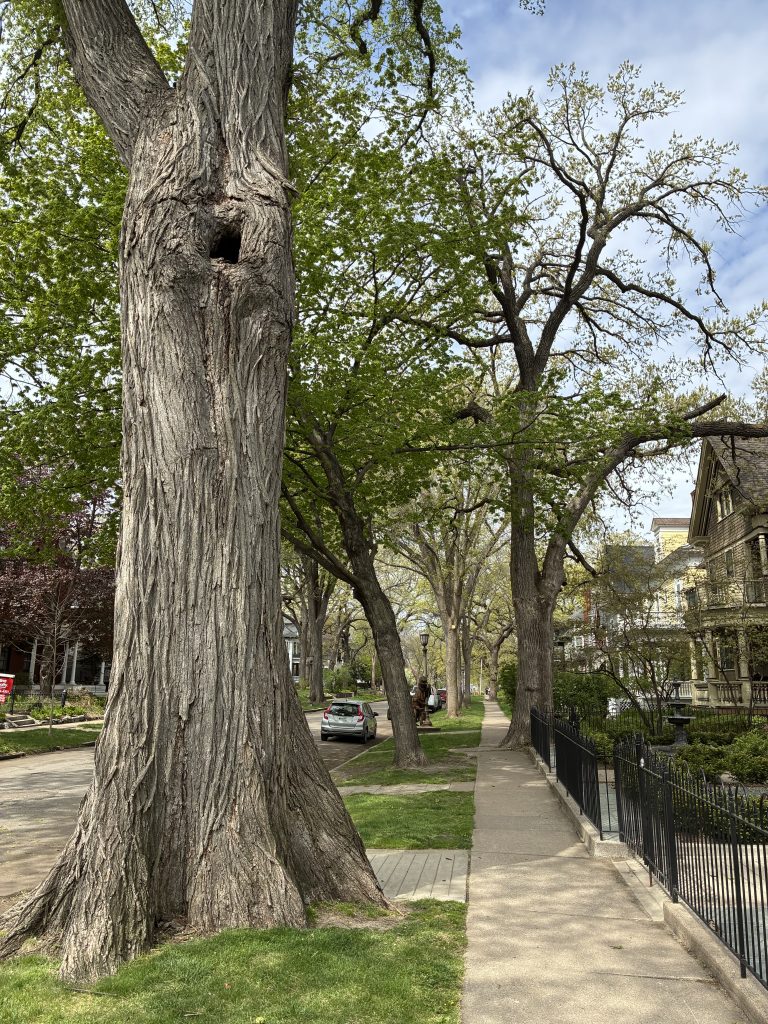
Looking west along shady Holly Avenue, a robust and gnarled tree rises from the wide boulevard, filling the expanse between the sidewalk and granite curb.
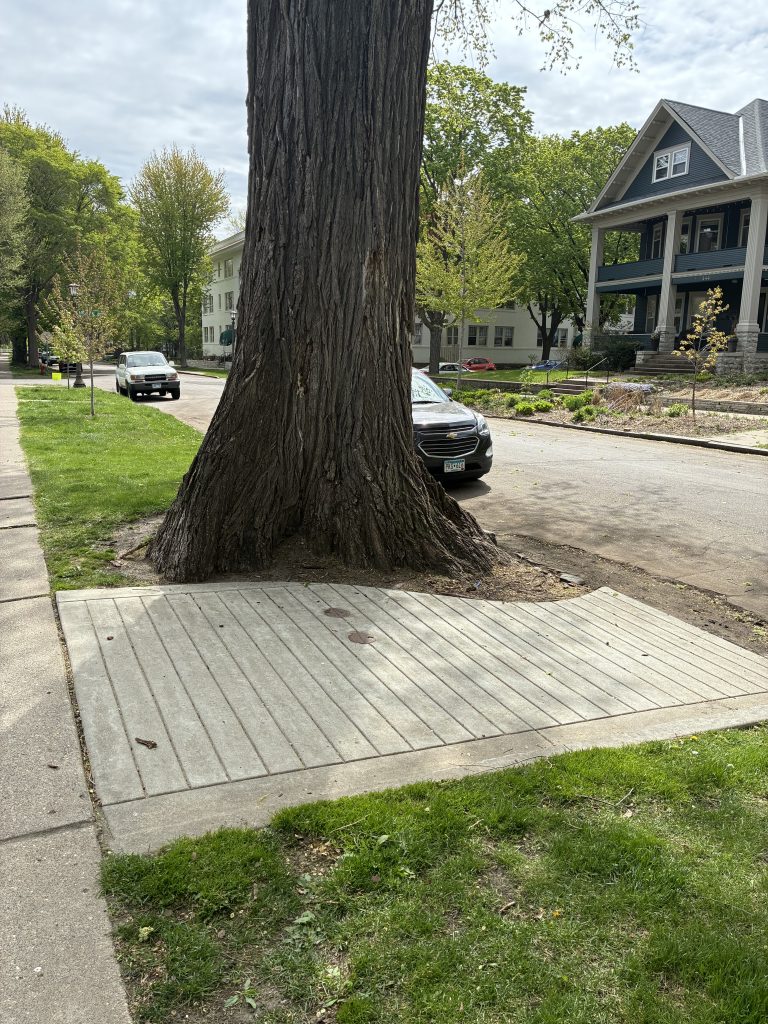
Walking past the large tree, one sees that the driveway was poured with care, to avoid the tree, with a gentle curve to allow for further growth. The photographer on this outing remembers when the tree was smaller, and that room was left for the tree to continue to grow.
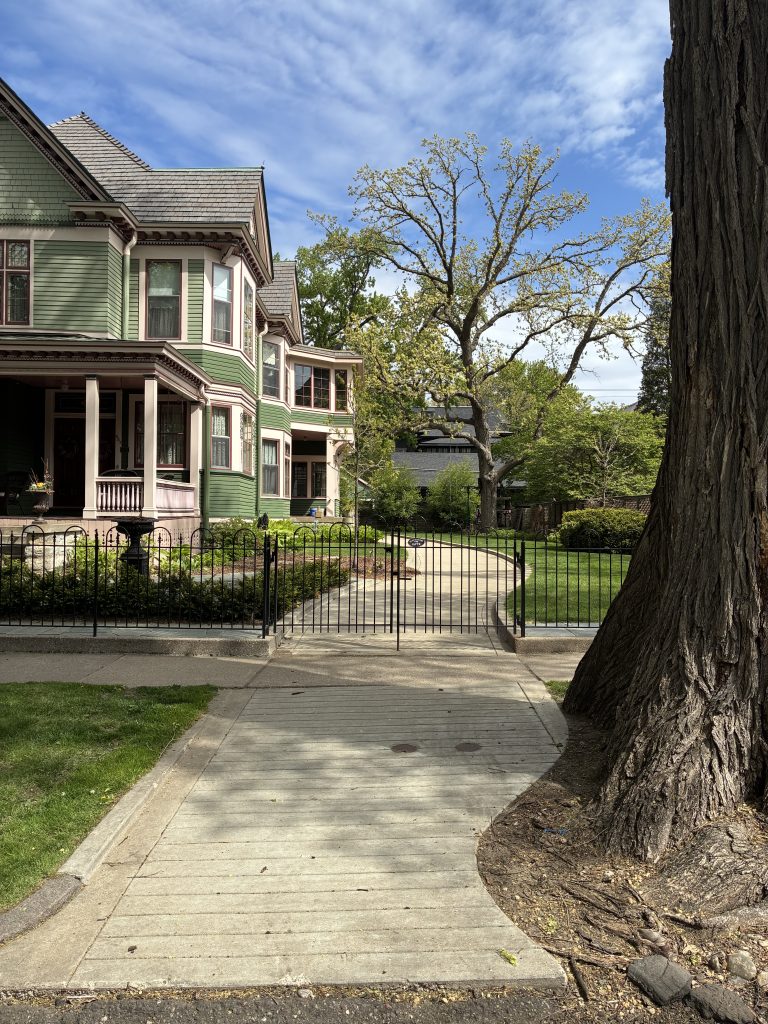
The immediate circular area surrounding the base of a tree is its critical root zone, and most be protected during (and from!) construction. In this case, the driveway was routed to avoid the tree, and appropriate care was shown when installing the driveway. The tree has continued to grow and thrive, creating comforting shade still, decades and decades after the driveway came to be.
Walking west a few dozen feet, one finds another example of a tree that predates the platting of Woodland Terrace and its sidewalks. (The driveway tree is visible in the background.)
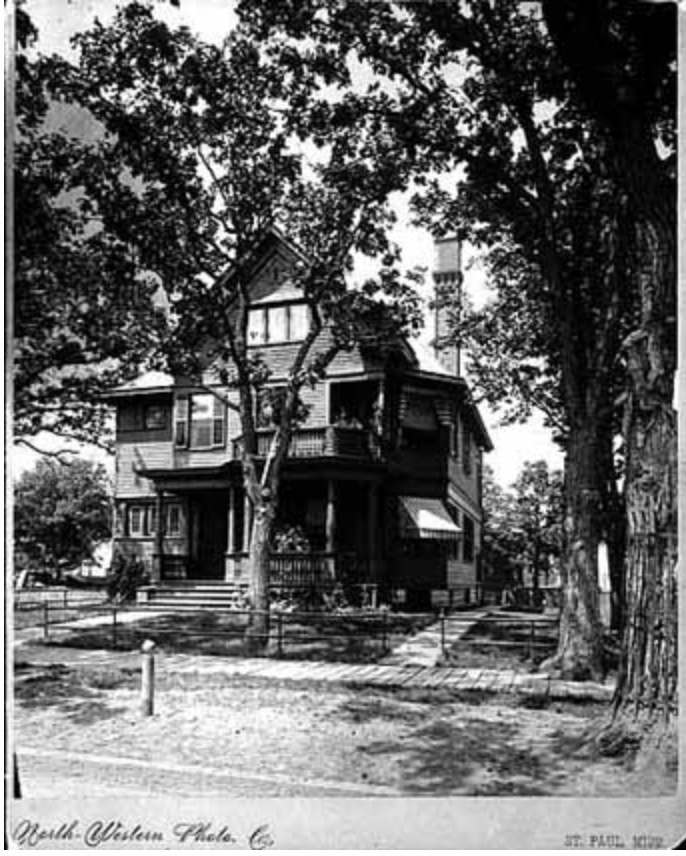
Courtesy of the Minnesota Historical Society (MNHS), we have a historic image showing the “sidewalk tree”: an 1890 image of the Everett H. Bailey Residence. It shows three established, already mature trees, including a younger version of our sidewalk tree. There appears to be a wooden sidewalk cut around the base of the tree, as the concrete sidewalk still does today.
Also courtesy of MNHS, here is the same tree (viewed from the opposite direction), in 1900:
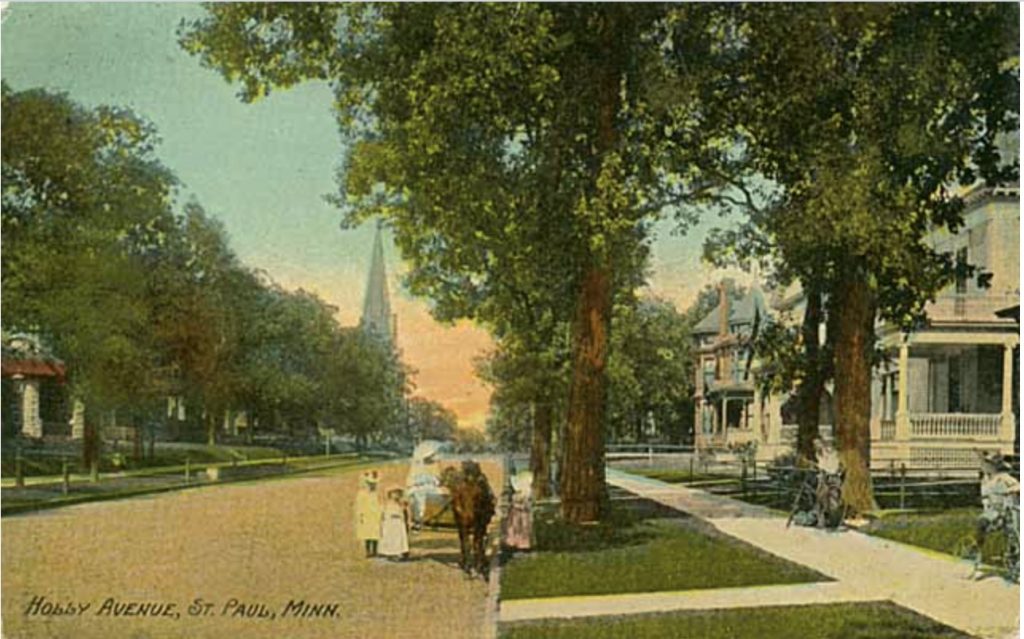
The 1900 postcard shows a bicycle leaning against the trunk of the tree, and bright white sidewalks. The sidewalk has just the smallest of curves, revealing that the sidewalk’s path was further adjusted later, sometime after 1900 and before the 1980s.
Before it became a block of stately homes, this section of Holly must have been intensely wooded. On the same block, we have a second example of a sidewalk tree (the view is now looking eastward), this one a majestic oak that long predates the platting of Woodland Terrace, and its comfortable sidewalks.
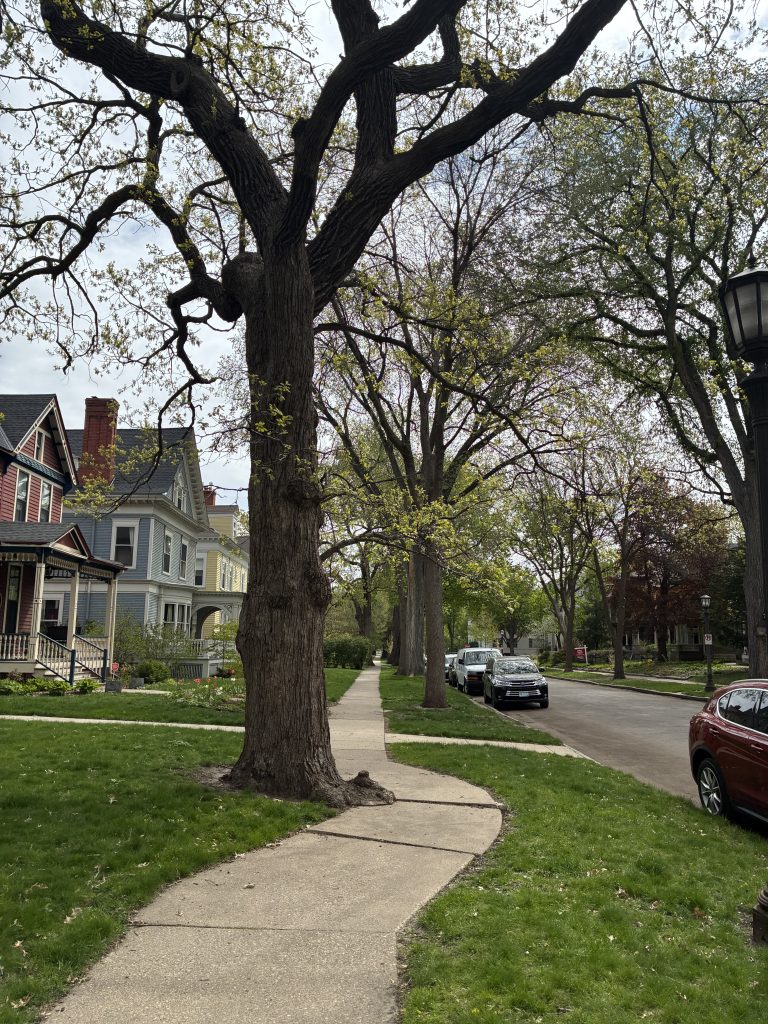
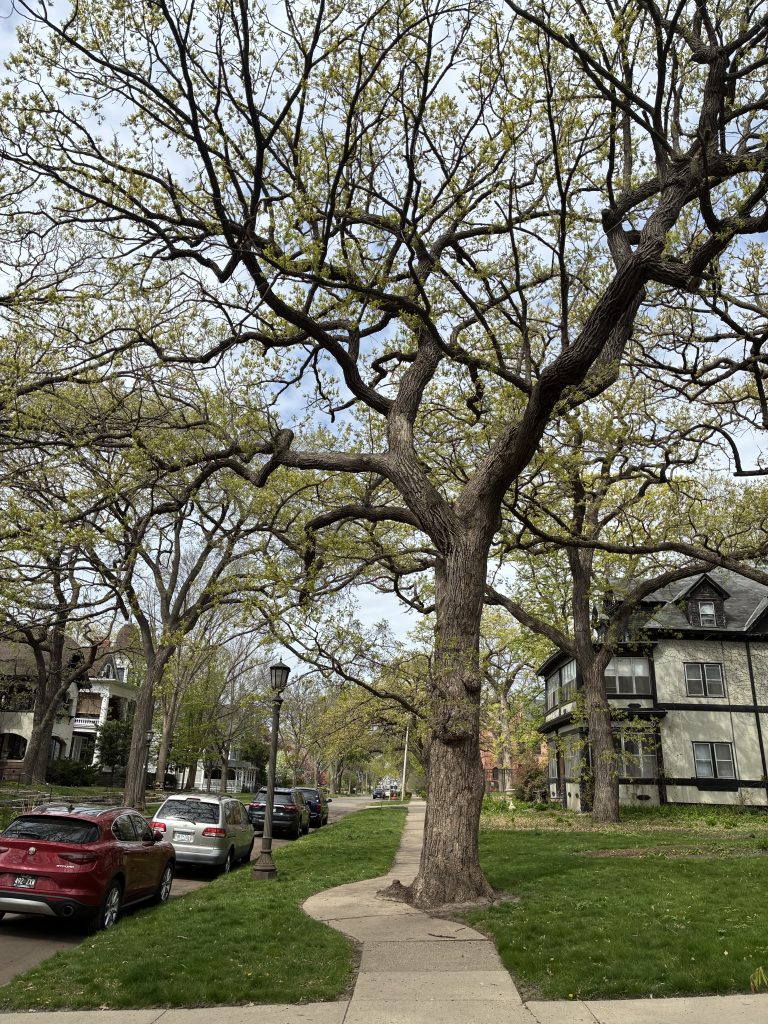
Here is a May 2026 view of the same tree (looking west). Behold the sublime beauty of the twisting branches. To experience the grace and enormity of this tree is to be humbled. And, to feel gratitude for the forethought of the men and women of the turn of the 19th century, who preserved and protected these magnificent trees.
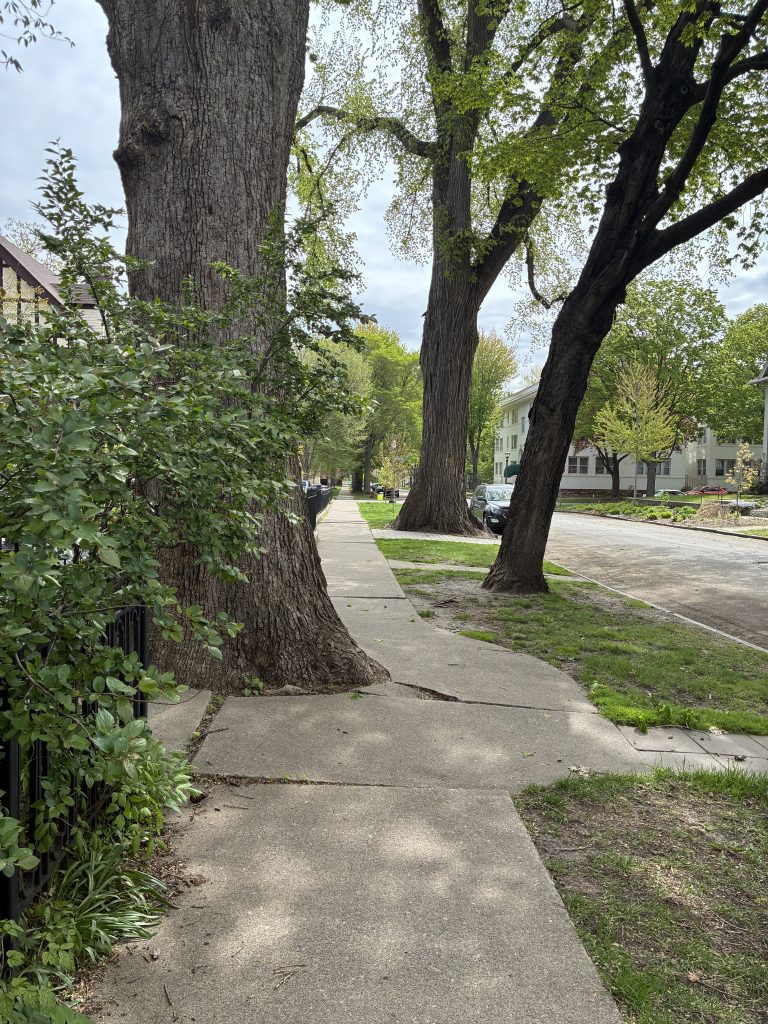
One can find several examples of trees being wrapped, rather than removed, for the public sidewalks on Ramsey Hill. While the shade and dappled light is the main joy, the curve in sidewalk, too, improves and enhances the experience of strolling.
Here again, on Arundel (in the middleground):
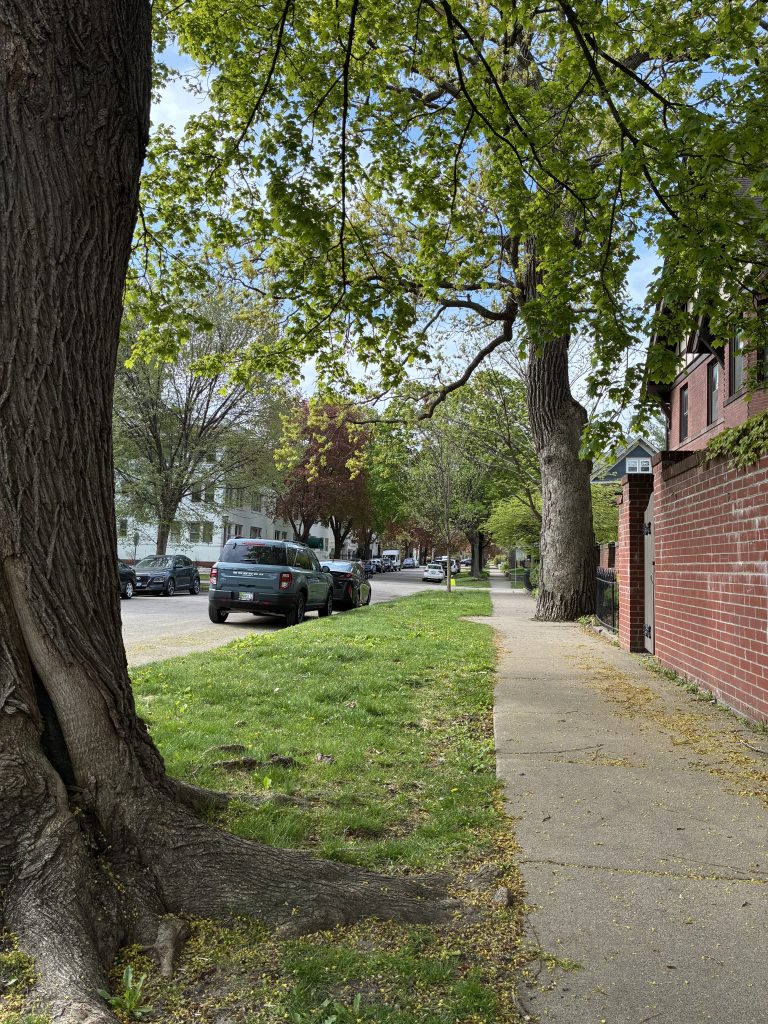
Just look at the huge girth of the centuries-old tree!
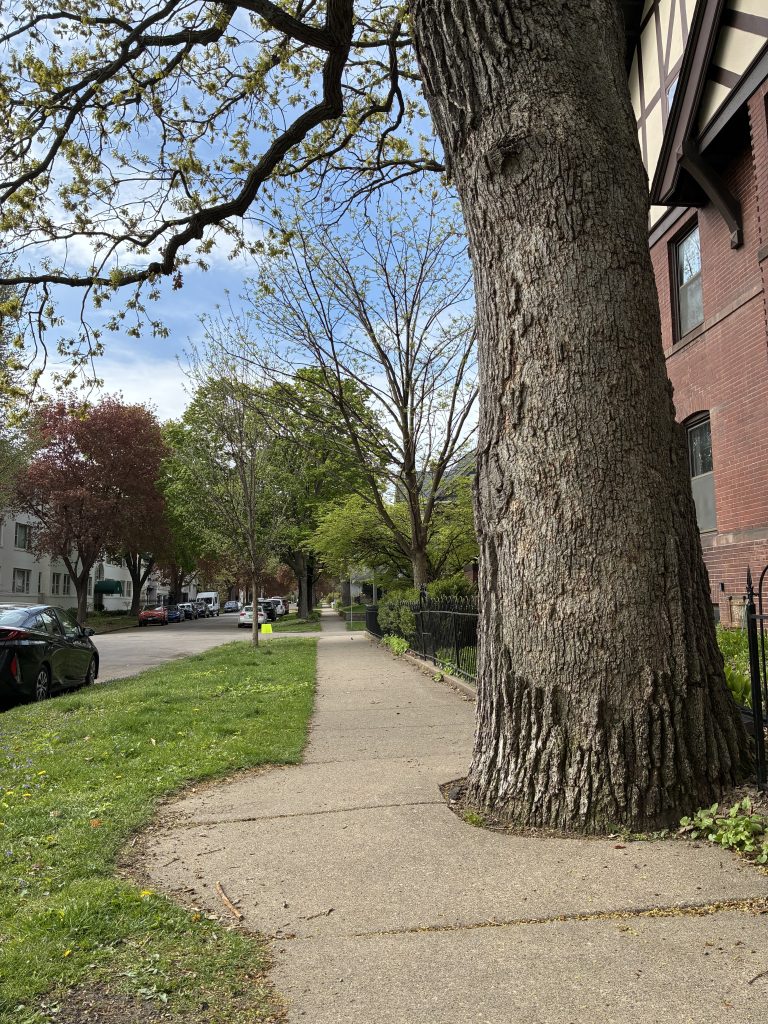
And on Laurel, we have the fat trunk jutting beyond the civil engineer’s line of the sidewalks edge, but rather than curving, the sidewalk slims, creating a point of compression:
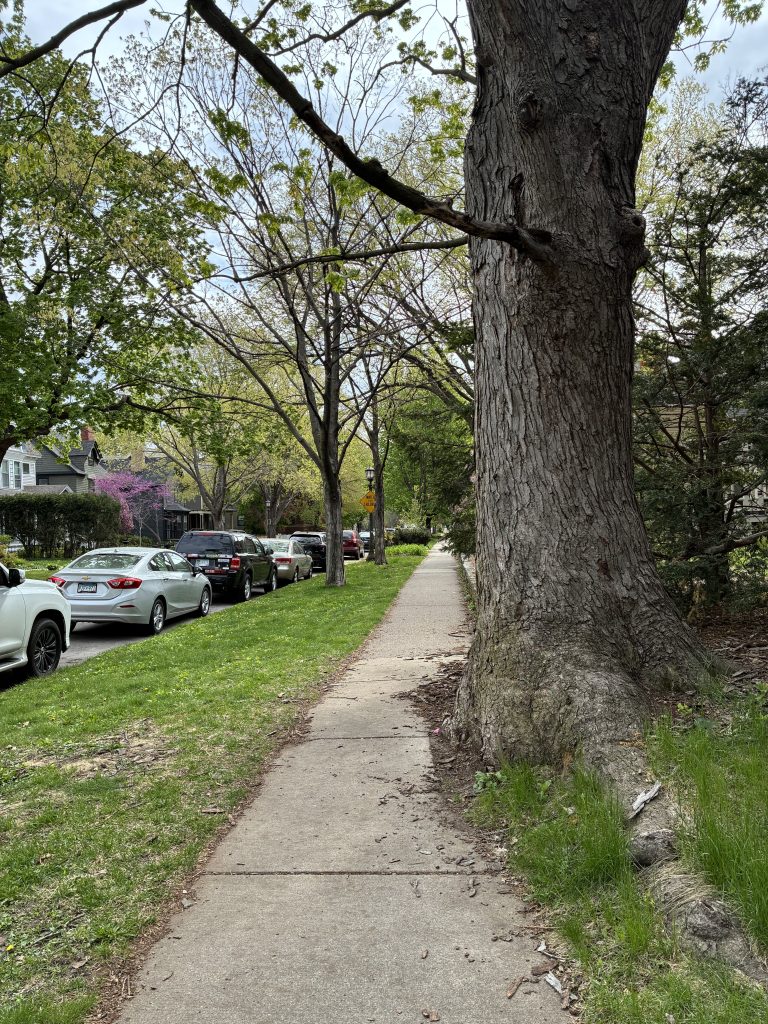
These anomalies create a rich tapestry, improving the experience of strolling through this historic neighborhood.
And yet another — now on Mackubin Street, a driveway skirts around a stately maple.
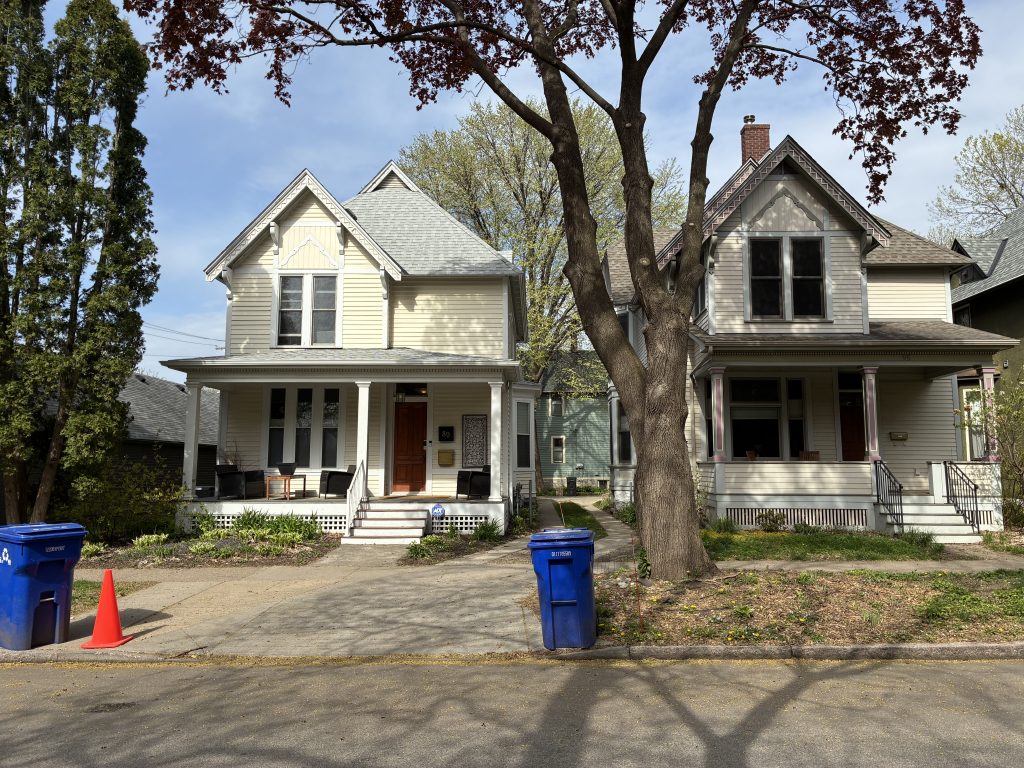
The preservation of these trees nearly 150 years ago, during times when basements were dug with horse-pulled excavators, is remarkable. Houses were built, water and sewer lines were installed and connected; the roadway was laid and lined with granite curbs; sidewalks were built—in short, a neighborhood was created, all without the “need” to clear cut every tree in the vicinity.
It draws sharp critique of efforts now, when we have the benefit of modern technologies like directional boring available to protect our tree canopy, why on earth would trees be removed for (poorly planned) bike trails rather than protected and saved for shade, beauty, and enjoyment?
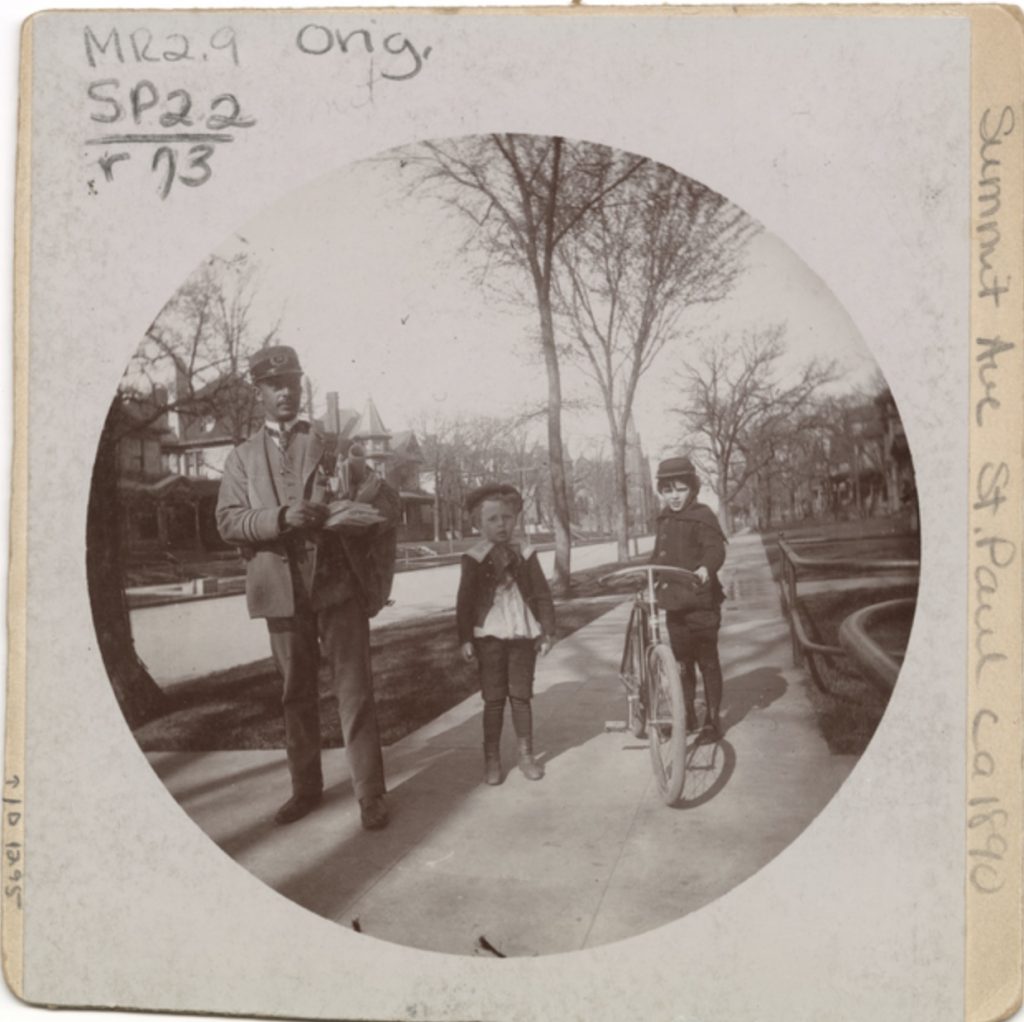
The pedestrians of 1890 knew the value of shady sidewalks. SOS stands for preserving the trees of Saint Paul for future generations. With proper planning, we can have good roads, good sidewalks, good bike routes, and protect our shady tree canopy.

Leave a Reply